Italy is one of those places where the hype is actually justified. That doesn't happen often with heavily-touristed countries -- usually reality is a letdown compared to the Instagram version. But Italy somehow delivers. The food really is that good. The art really is staggering. And the villages really do look like someone painted them.
The challenge isn't whether Italy is worth visiting. It's that there's so much worth seeing that you'll inevitably over-plan, try to cram too much in, and end up sprinting through Florence with gelato melting down your arm while you try to make a train you should have caught twenty minutes ago. We've been there. Literally.
The other thing about Italy is that it varies enormously from north to south. Northern Italy feels more Central European -- efficient, wealthy, colder. The south is rougher, louder, cheaper, and in many ways more rewarding. Rome sits in the middle, being its own chaotic, layered, eternal thing. Whatever you think "Italy" is, it's probably only one slice of a much more complex country.
This is what we've figured out from multiple trips, some planned well, some planned terribly.
The Geography
Northern Italy has the Alps, the lakes, the industrial cities (Milan, Turin), and Venice. It feels more European and holds much of Italy's wealth. Central Italy covers Tuscany, Umbria, and Rome -- the Italy of most people's imaginations, with rolling hills, Renaissance art, and ancient history. Southern Italy means Naples, the Amalfi Coast, Puglia, and Sicily. It's rougher and more authentic, with arguably the country's best food and warmest people.
Rome
Rome layers about 3,000 years of history onto every street, and it manages to be a functioning modern city at the same time. It's chaotic and beautiful and occasionally infuriating.
For ancient Rome: the Colosseum needs skip-the-line tickets (don't waste time in that queue). The underground and arena floor access options are worth the extra cost for a less crowded, more interesting experience. The Roman Forum and Palatine Hill come on a combined ticket with the Colosseum. The Pantheon is free and is honestly one of the most impressive buildings you'll ever walk into -- the oculus is extraordinary. The Baths of Caracalla are less crowded and host summer opera performances, which is a great way to experience them.
For the Vatican: St. Peter's Basilica is free but has long lines; go early morning or evening. The Vatican Museums and Sistine Chapel require online booking, which is non-negotiable. Friday night openings have smaller crowds and are worth scheduling around. Castel Sant'Angelo is a former papal fortress with excellent views and tends to be overlooked.
The neighborhoods matter in Rome. Trastevere has the cobblestones and ivy-covered walls and the best evening atmosphere. Centro Storico is the tourist core: Piazza Navona, Campo de' Fiori, the Trevi Fountain area. Testaccio is where Romans actually eat -- authentic food, some clubs, and zero pretension. Monti has a bohemian feel with boutiques and wine bars near the Colosseum.
For food in Rome: carbonara, cacio e pepe, and amatriciana are the local pasta specialties (don't order fettuccine alfredo -- it doesn't exist here). Suppli are fried rice balls you eat standing up. Pizza al taglio is by-the-slice sold by weight and is a perfect lunch. And aperitivo -- pre-dinner drinks with free snacks -- is a ritual you should absolutely adopt.
Florence
Florence is essentially an open-air Renaissance museum that happens to have residents. It's smaller and more walkable than Rome, but the crowds concentrate heavily around the main attractions.
The Uffizi Gallery (Botticelli's Venus, among many others) requires advance booking. The Accademia houses Michelangelo's David -- see it first thing in the morning or at last entry. Palazzo Pitti and the Boboli Gardens were the Medici palace and are excellent if you want a break from gallery-hopping. Climbing Brunelleschi's dome (463 steps, no elevator) rewards you with the best views of the city.
Beyond the art: Ponte Vecchio is the medieval bridge lined with jewelry shops. San Lorenzo Market sells leather goods and souvenirs. The Oltrarno neighborhood across the river has artisan workshops and a calmer pace. Day trips to Siena, San Gimignano, and Tuscan wine country are all easy from Florence.
Eat bistecca alla fiorentina (massive T-bone steak), try lampredotto if you're adventurous (it's a tripe sandwich -- sounds terrible, tastes great), have multiple gelatos per day without guilt, and drink Chianti.
Venice
Venice exists outside normal reality. Built on water, completely car-free, slowly sinking, and still somehow magical despite centuries of tourism beating it up.
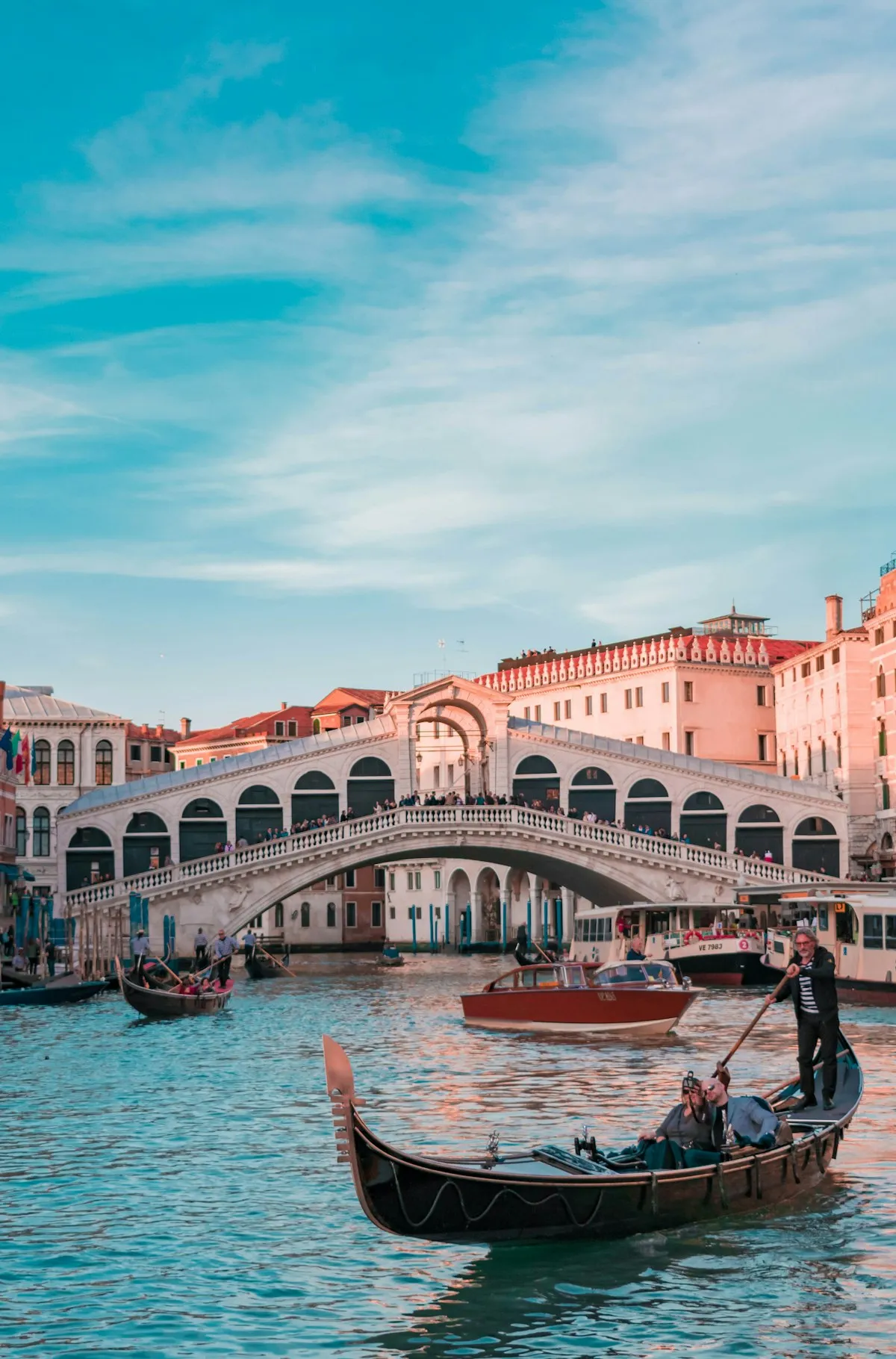
The best thing to do in Venice is get lost. Seriously -- put the phone away, pick a direction, and walk. San Marco (the piazza, basilica, and Doge's Palace) is pure tourist central but you can't skip it. The Rialto Bridge and its morning fish market are worth seeing early. Take the vaporetto (water bus) line 1 down the Grand Canal for a slow, scenic ride that costs a fraction of a gondola. Murano and Burano -- the glass-making island and the colorful-houses island -- are easy half-day trips.
To avoid getting ripped off: never eat on St. Mark's Square (the prices are genuinely absurd). Get away from San Marco for authentic bacari (wine bars) where locals actually drink. Stay at least one night -- Venice transforms completely when the day-trippers leave. Take water buses instead of gondolas unless money isn't a concern.
Tuscany
Sunflower fields, cypress trees, medieval hill towns. Best explored by car, which is actually one of the few parts of Italy where driving is pleasant rather than terrifying.
Siena is a medieval city with an incredible shell-shaped piazza and the annual Palio horse race. San Gimignano is a tower-studded hill town with famously good gelato. Lucca has walls you can walk or bike on top of. Montepulciano and Montalcino are wine towns with stunning views.
For wine specifically: Chianti is the classic region between Florence and Siena. Brunello di Montalcino is the premium stuff with vineyard tours. Val d'Orcia is the UNESCO-listed landscape of gentle hills that shows up on every calendar and desktop wallpaper -- and it really looks like that in person.
The Amalfi Coast
Cliffside villages, Mediterranean views, and Italian coastal luxury. It's expensive and worth it, though I'd say the scenery is more impressive than the towns themselves.
Positano is the poster child -- undeniably beautiful, extremely crowded, and pricey. Amalfi is the namesake town with a historic cathedral. Ravello is a hill town above the coast with famous gardens and arguably the best views. Praiano is our recommendation for a quieter base with better-value accommodation.
The narrow coastal road terrifies most drivers, and we wouldn't recommend renting a car here. SITA buses are cheap but packed. Ferries are scenic and weather-dependent. Private drivers are expensive but stress-free. You can walk between some towns on old paths, which is actually a highlight.
A good alternative to staying on the coast: base yourself in Sorrento or Naples for easier access and much lower costs, and day-trip to the coast.
Naples and the South
Naples is raw and chaotic and home to the best pizza on earth. It rewards travelers who can handle a bit of grit. Sorbillo, Da Michele, and Starita are the legendary pizza spots -- accept the lines. The Archaeological Museum has the best Roman artifacts pulled from Pompeii. Spaccanapoli is the street that literally splits the old city in half. Underground Naples (catacombs and Greek-Roman tunnels) is fascinating.
Pompeii and Herculaneum are easy day trips -- ruins preserved by the Vesuvius eruption. Pompeii is larger, Herculaneum is better preserved. If you only have time for one, honestly, Herculaneum might be the better experience. It's less crowded and more intact.
Further south: Puglia has the whitewashed trulli houses, olive groves, and Lecce's baroque architecture. Calabria is mountainous and almost completely undiscovered by tourists. Sicily deserves its own separate trip -- ancient ruins, active volcanoes, and food that's distinct from mainland Italian cuisine.
Getting Around
High-speed trains between major cities are excellent. Book through Trenitalia or Italo. Regional trains are slower and cheaper, good for day trips. Rental cars are essential in Tuscany, Puglia, and rural areas, but are a nightmare in cities (parking, ZTL zones, aggressive drivers). Domestic flights between north and south can be surprisingly cheap.
Accommodation
Book ahead for Florence and Venice, especially in summer. Agriturismos (farm stays in the countryside) are a uniquely Italian experience worth trying. Apartments with kitchens offer better value and are practically necessary for longer stays.
Budget: roughly 70-100 euros per day. Mid-range: 150-200. Comfortable: 250+. The north is more expensive, Rome and Florence have tourist pricing in their centers, and the south offers the best value by a wide margin.
Practical Notes
Italian is more important than you'd expect outside tourist zones. Learn menu vocabulary, basic greetings and politeness, and numbers. You'll get further and be treated better.
Tourist areas have well-practiced scams: people handing you roses then demanding payment, fake petition signers, restaurants without visible prices that overcharge, and taxis with conveniently broken meters. None of these are dangerous, just annoying. Know they exist and politely decline.
When to Go
April through June and September through October are the best months. Avoid August if you can -- Italians themselves go on vacation, many businesses close, and beach towns are overwhelmed. Winter is cold but uncrowded; Venice floods but is moody and atmospheric in a way summer tourists never see.
Sample Itineraries
10 days, classic: days 1-3 in Rome, train to Florence for days 4-6 with a Tuscan day trip, train to Venice for days 7-9, fly out day 10.
2 weeks with the south: add days 10-11 in Naples with Pompeii, then days 12-14 on the Amalfi Coast.
1 week focused: days 1-3 in Rome, days 4-6 on the Amalfi Coast (high-speed train to Naples, then transfer), day 7 return.
On Pace
Italy rewards slowness. A two-hour lunch isn't inefficiency -- it's the whole point. Coffee is sipped standing at the bar, not carried around in a paper cup. Dinner begins late and ends later.
The country's appeal comes from living well rather than living fast. Good food, good wine, good company, beautiful things. Trying to rush through Italy is a bit like fast-forwarding through a movie. You'll technically see it all, but you'll miss everything that matters.